Henry Wykys
Wolf HallHenry Wykys, a prosperous wool merchant and father of Lizzie, becomes an early patron and family connection of Thomas Cromwell. His story shows Cromwell’s ability to turn commercial knowledge into practical service: he identifies where Wykys’s business has gone wrong, improves its management, and becomes his son-in-law. Wykys’s trust in him rests not on polish or status, but on his capacity to make people and accounts work.
Identity and Background
Wykys is a Putney man who has made a tidy fortune in the wool trade. He is shrewd, though by the time Cromwell enters his life he has grown tired and let the business slide. His established commercial standing gives Cromwell access to a world of trade and family connection, while Wykys’s own willingness to listen makes him more than a passive employer.
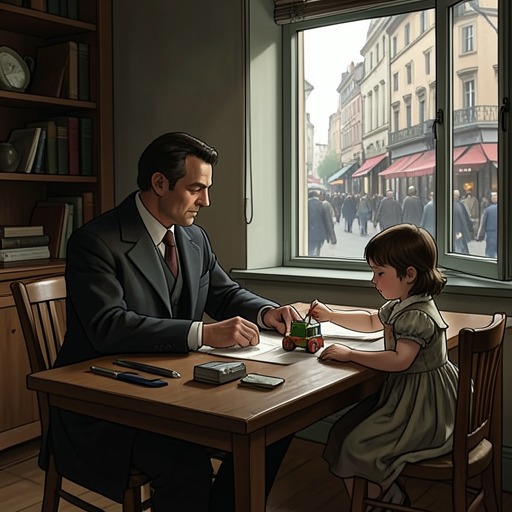
Cromwell first comes to him over a legal matter, in his mid-twenties and recently returned from abroad. Wykys recognizes him as Walter Cromwell’s son and remembers the rough boy he had been. When he asks what changed him, Cromwell replies that he found an easier way to be. The brief exchange marks both Wykys’s familiarity with Cromwell’s past and the distance between that past and the capable adviser before him.
Business Partnership and Recovery
Wykys’s business is still sending broadcloth to the north German market, but he believes it should move toward lighter kerseys, which could be exported through Antwerp to Italy. He knows that he ought to show his face at Antwerp and Bergen op Zoom, yet dislikes the crossing. Cromwell offers to accompany him and reassures Mistress Wykys that he knows a family with whom they can stay. Her teasing cautions against strange drinks, women, and banned preachers in cellars establish both the familiarity of the household and her awareness of Cromwell’s habits.
The journey takes Wykys and Cromwell to Antwerp by boat. Wykys feels unwell at sea, while Cromwell stays on deck and makes himself useful; a fellow passenger guesses that he must once have been a ship’s boy. At the sign of the Holy Ghost, the people who greet Cromwell remember him as their runaway, beaten-up friend. The contrast between this welcome and Wykys’s business purpose places the merchant inside a wider network of relationships, one that Cromwell can draw upon as readily as he can read an account book.
Back in London, Cromwell does not stop at reviewing Wykys’s stock and accounts. He asks to see the clerks, recognizing that staff, not ledgers alone, are the key to the business. He dismisses the doubtful chief clerk and gives the work to a stammering junior whom others had mistaken for stupid. By examining the boy’s work each night and pointing out errors without humiliating him, Cromwell helps him become competent and eager within four weeks. He also checks the docks for dishonest dealing. By the end of the year, Wykys is back in profit.
This recovery is a measure of Wykys’s trust in Cromwell’s judgment as well as Cromwell’s ability to make it effective. The solution combines a change in personnel, close attention to daily work, and scrutiny of the docks; the return to profit follows from those practical interventions rather than from a single stroke of luck.
Marriage and Family
After showing Wykys the improved figures, Cromwell calls down Lizzie and asks her father whether he wants a new husband for her. Wykys appears baffled that the matter might not be settled immediately by sitting down to write a contract. Lizzie looks Cromwell over and remarks that her father had not chosen him for his looks, then asks Cromwell whether he wants a wife. Their exchange is brisk and candid, in keeping with the commercial world in which all three move.
The match has mutual advantages, but the account specifies different priorities. Lizzie wants children; Cromwell wants a wife with city connections and some money behind her. They marry within weeks, and Gregory is born within the year. Wykys’s role is consequential: his business relationship with Cromwell becomes a marriage connection, linking Cromwell to Lizzie’s family and urban contacts.
Memory and Narrative Significance
Later, Cromwell remembers Wykys with affection. At an early hour he misses Lizzie’s father, recalling him as a good old man who rose early and would place a flat hand on his head and wish him a good day. This memory is not confined to business dealings: it gives Wykys a place in Cromwell’s private life as a source of warmth and welcome.
Wykys also helps make legible the social method behind Cromwell’s advancement. Cromwell reads accounts, but he also reads people: he notices a junior clerk’s timidity rather than dismissing him as stupid, restores a failing enterprise, and earns the confidence that permits a rapid marriage into the family. Wykys’s story is brief, yet its sequence—recognition, partnership, renewed prosperity, and marriage—shows how Cromwell’s practical skill and personal relationships reinforce one another.